
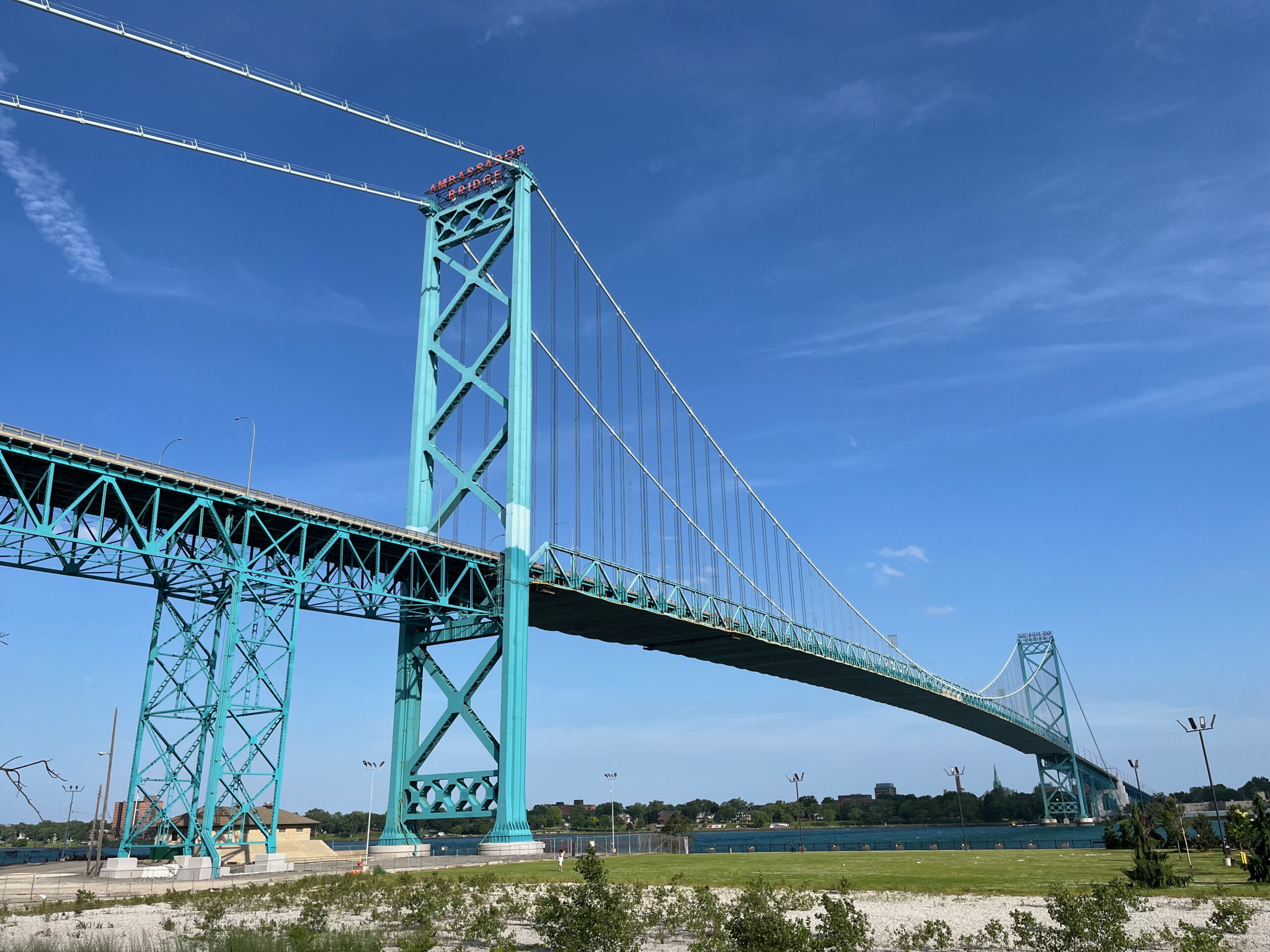
Detroit, Michigan is home to the Ambassador Bridge, which links Detroit to the Canadian border city of Windsor. The Ambassador is essential. CNN once called it “the most economically important one-and-a-half miles of roadway in the Western Hemisphere.” And every day, endless lines of trucks wait for hours, so they can be processed by a border agent.
Everybody – the auto industry, importers, tourists heading north – has to use this bridge, because they have virtually no other choice. There’s a tunnel nearby but it’s too small for most trucks to drive through. And the next-closest international bridge is some 65 miles away.
Which creates a problem, because the bridge is very unpopular with locals. To get to the bridge, freight trucks first have to drive by a residential neighborhood in southwest Detroit called Mexicantown. And for many years, they had to drive right through it. Mexicantown is right at the bridge’s entry point, and residents have suffered through loud honking and negative health effects for decades.
Sam Butler, president of a local neighborhood group, says it’s not uncommon for residents to clean black soot off their windows. Residents in Windsor don’t like the bridge, either, as it’s not well maintained. Large chunks of concrete have been known to break off and fall on the streets below.
While they have complaints about the bridge, locals can’t petition the city, or the county, or even the US or Canadian governments with their concerns. That’s because none of those entities own this bridge. The Ambassador is privately owned. In fact, for the longest time, the Ambassador Bridge was owned by one man, a very private businessman named Matty Moroun.
Private Ownership
When Matty Moroun took control of the bridge in 1979, virtually nobody outside the Detroit business community knew him. “His basic biography ought to be that of rags to riches, American hero,” says John Gallager, a retired Detroit Free Press journalist. “[But] instead he’s probably the most disliked businessman in Detroit, by far, in a couple of generations.”
Moroun started working in his father’s garage after college and tenaciously grew that into a local trucking empire. He outbid some fierce competition, including from Warren Buffet, to get total ownership of the bridge in the 70s, and according to Gallagher, he quickly became a notorious figure.
Detroit’s wealthiest businessmen tended to give a lot to local charities, especially when the city started losing people in the mid-20th century. But Matty Moroun wasn’t a big public philanthropist. Instead, he focused on expanding his bridge empire. In the 1980s, Moroun bought up a whole bunch of land near the bridge. Then, he presented a plan to expand the Ambassador’s opening plaza. This expansion was so the bridge could accommodate more traffic, and bring in more tolls.
But in buying up this land, Moroun intruded on a vibrant local community next door. Anthony Benavides is a Southwest Detroit community activist. He says the Morouns used a tactic called “block busting” to buy up local real estate. “He was strategically buying houses throughout the block. And just letting them sit there. They were vacant, so of course you had drugs, you had prostitutes, you had wild dog,” says Benavides.
Sometimes sales agents gave no indication they were there on behalf of the Morouns to acquire more land. To obscure their employer, these agents would represent businesses with names like “Mexicantown Real Estate Company.” Many unsuspecting homeowners were desperate to get out of the area that was being hollowed out, and were happy to sell. Only later did they learn the truth about who bought their property.
Matty Moroun became a true baron of Detroit real estate. One website that tracks landlords in the city estimates the Morouns have owned as many as 978 properties in Detroit alone. He built an empire, with the Ambassador Bridge at its center.
That said – a lot of the property Moroun was buying was nowhere near the bridge. And much of what they bought was left to deteriorate. Moroun accumulated so many blight tickets over the years that his company struck more than one deal with the city to pay them off in negotiated lump sums.
Steve Tobocman, a former state representative, says this pattern of buying property and letting it go to seed, was happening a lot in Detroit around this time. The city was declining rapidly in the 80s, and land was selling for cheap.
That meant land speculators could sweep in, take advantage of an economic downturn and hoard real estate just in case Detroit ever made a comeback. “If you can buy that property for $500, $1,000, $3,000, I guess you’re investing that on a speculation that hopefully one day, someday, somebody comes and wants to buy that property,” says Tobocman. “And they’re willing to pay you multiples of that few-thousand-dollar purchase price, and the properties become valuable.”
NAFTA and Public Protest
While many of their properties fell into disrepair, Matty Moroun still made huge profits. Because his main business, the Ambassador Bridge, became even more indispensable after the passage of NAFTA in 1992. NAFTA led to a big increase in commerce between the United States and Canada, and made the bridge essential. Forbes magazine once estimated the bridge makes 60 million dollars in revenue every year.
After the passage of NAFTA, Matty Moroun became notably more ambitious in his dealings with Detroit. He made a pretty brazen move to expand his business, by starting construction on a second bridge, right beside the first one.
Traffic had increased so much on the Ambassador, there was clearly demand for another bridge. Matty Moroun didn’t have permission from the city of Detroit, or the city of Windsor, or from anybody, to start building a new bridge. In fact, Matty Moroun was supposed to be doing something completely different, something positive for the community. In 2004, Moroun signed a 258 million dollar deal with the city for an initiative called The Gateway Project.
For the Gateway Project, the government agreed to build more roads to ease traffic. And in exchange, Moroun promised to build entryways to connect the bridge to the highway system, so trucks would no longer have to drive through the Mexicantown neighborhood. It seemed like a great deal for everybody. But instead of holding up his end of the bargain, Matty Moroun’s company started construction on a second bridge in 2007. They didn’t get very far. In the end, they only built two ramps that didn’t connect to anything.
Locals protested this lack of progress. “There’s people that laid on the road so his trucks couldn’t go through,” says community activist Anthony Benavides. “Literally laid on the road. That’s how involved they were. They literally put their bodies in front of trucks.”
The Metro Times, the local Detroit alt weekly, published a cartoon depicting Moroun as Mr. Burns from the Simpsons. Protestors carried a giant puppet of Matty Moroun and paraded him in front of Michigan Central, where they chastised him for owning so many blighted properties.
Despite these protests, and pushback from politicians like Steve Tobocman and Congresswoman Rashida Tlaib, the Morouns still largely got their way. That is, until January 2012, when Moroun and his longtime right-hand man, Dan Stamper, were hauled before a county judge. Fed up with their foot-dragging on the Gateway Project, the judge ordered both of them to spend one night in jail. Moroun was 84 years old at the time.
For a long time, it seemed like the Morouns’ bridge monopoly would never end. Ultimately, the only group of people with the clout and the ability to stand up to the Morouns…was the Great White North.
The Second Bridge
Beginning in 2004, the Canadian government made a series of proposals to build a second bridge. Their bridge would link up directly with the freeway, making the trip easier for truckers and the quality of life better for the neighborhoods in Detroit. It would also introduce competition, and bring back pedestrian walkways. The Ambassador had closed theirs years ago.
A Canadian diplomat named Roy Norton was a public face of the effort. He made it clear – breaking up the Morouns bridge monopoly would be no easy task. But Canada was dedicated to building their own stretch of bridge.
In 2012, an agreement was reached. A second bridge would be built and controlled entirely by the Canadian government, who would pay for the whole thing. It would be named the Gordie Howe Bridge, in honor of the Canadian hockey star who played most of his career with the Detroit Red Wings. A symbol of binational unity.
The Morouns fought this proposal with some pretty aggressive tactics. In 2011, when the Gordie Howe was still in the planning stage, a bunch of yellow “Eviction” notices went up in a neighborhood close to the proposed bridge site. It turns out, the notices were fake, and intended to sow opposition to the new bridge. A conservative lobbying group, Americans for Prosperity, took credit for this tactic.
Then there was the ballot box. Matty Moroun spent more than 30 million dollars to get an amendment passed by Michigan voters, called Proposal 6. Proposal 6 would make all future bridge projects subject to a referendum by both state and local voters, which would make projects like the Gordie Howe more difficult.
Groups supported by Matty Moroun ran ads implying that voters, somehow, would have to pay for the Gordie Howe Bridge. And that Proposal 6 would stop that from happening.
Ultimately, the bridge amendment failed, with 60% of voters rejecting it. And this fall, The Gordie Howe Bridge is set to finally open.
In 2020, Matty Moroun died at the age of 93, from heart failure. He had already transferred control of the family’s enterprises, including the bridge, to his son Matthew. Since then, the Morouns have continued to receive pushback for many of their business ventures. But, the tone and the family’s tactics have softened, according to locals. The Morouns have held public events, and reached a community agreement with Southwest Detroit that clearly defines where they can build, and where they can’t.
For decades, the Morouns’ have been seen as civic villains by lots of people in Detroit. Maybe things would have turned out differently if a different family had owned the bridge. But local organizer Kathy Wendler says it doesn’t matter. To her, there’s a much simpler lesson here: “International border crossing shouldn’t be privately owned.”

Leave a Comment
Share