
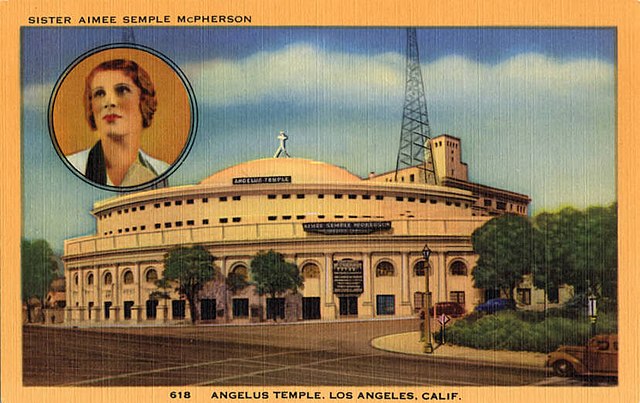
In Echo Park, Los Angeles, across from Echo Park Lake, stands a building that begs to be noticed—a colossal, white structure with archways and an enormous concrete dome that’s been described as “half Roman Coliseum, half Parisian opera house.” Though some might say it looks more like a concrete flying saucer landed on top of the Rose Bowl Stadium.
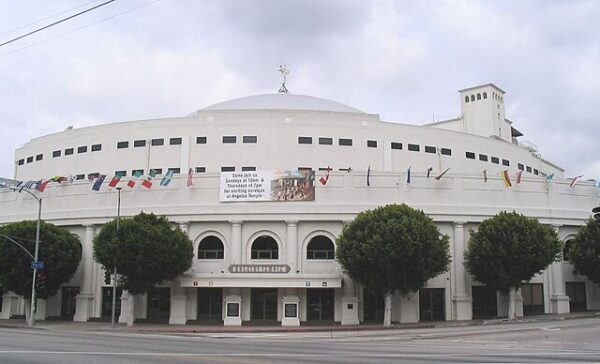
This is the Angelus Temple, regarded as the very first megachurch ever built in the United States. Opened in 1923, it predates the modern megachurch movement by half a century. When millions of Americans enter contemporary megachurches today, they unknowingly enter spaces pioneered by one extraordinary woman: Aimee Semple McPherson.
The Making of Sister Aimee
Born Aimee Kennedy in 1890 on a Canadian farm, she was an overachiever—top of her class, natural leader, and always looking for an opportunity to perform. At seventeen, she met a preacher named Robert Semple. Semple was an early convert of Pentecostalism, a new Protestant movement viewed as fringe because of its dramatic elements: faith healing and speaking in tongues. Followers were disparagingly called “holy rollers.”
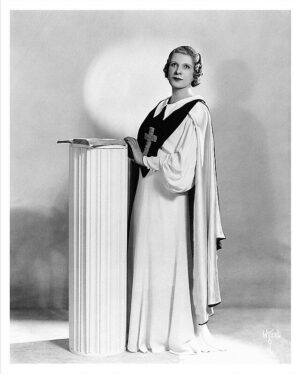
Aimee fell deeply in love with both Robert and Pentecostalism. She converted and married Robert, and together they traveled to China as missionaries. But tragedy struck—Robert died within a month of arrival. Aimee returned to the United States, married again, but fell into a severe depression. In this traumatic period, she had an epiphany: Jesus told her she had to spread the word. So McPherson left her second husband, packed her kids and mom into her car, and began life as a traveling preacher on the Sawdust Trail.
Unlike the testosterone-laden aggressive style of male preachers, Sister Aimee had a gentler approach. As William Schultz of the University of Chicago Divinity School explains, she packaged “a really domestic style,” projecting the image of a simple country person infused with divine power. She intuitively knew how to reach people, using megaphones and starting a monthly magazine. With her success, she was popularizing Pentecostalism itself.
Building the Million Dollar Temple
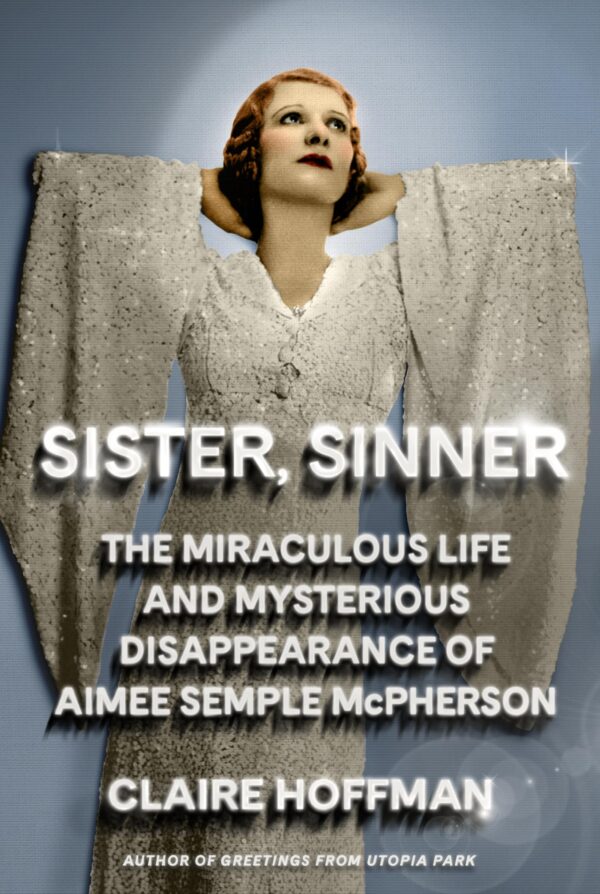
After her daughter nearly died from the 1918 flu, McPherson claimed she was “called by God” to build a permanent church in Los Angeles—a city packed with Christian migrants from the Midwest and South. She found an empty lot across from Echo Park Lake and imagined a grand coliseum-like structure with a soaring dome. But while those words conjure macho architecture, she built it to mirror her femininity. As Claire Hoffman, author of Sister Sinner: The Miraculous Life and Mysterious Disappearance of Aimee Semple McPherson describes it, “it looks like a wedding cake… it’s got lot of gilded, soft floral edges.”
In 1923, she opened the Angelus Temple—the largest church in America. The “million dollar temple” seated 5,300 people with a stage for a 100-person choir, full orchestra, and elaborate sets. The ceiling was painted blue like the heavens, dotted with puffy clouds.
McPherson put on the best show in town, incorporating vaudeville and Hollywood into her “illustrated sermons.” She tapped movie industry professionals for stage management, set design, and lighting. Lions, camels, elaborate costumes, and musical theater productions filled the stage, with Sister Aimee as the riveting center. Soon they needed three Sunday services, sometimes cramming over 7,000 worshippers into the space.
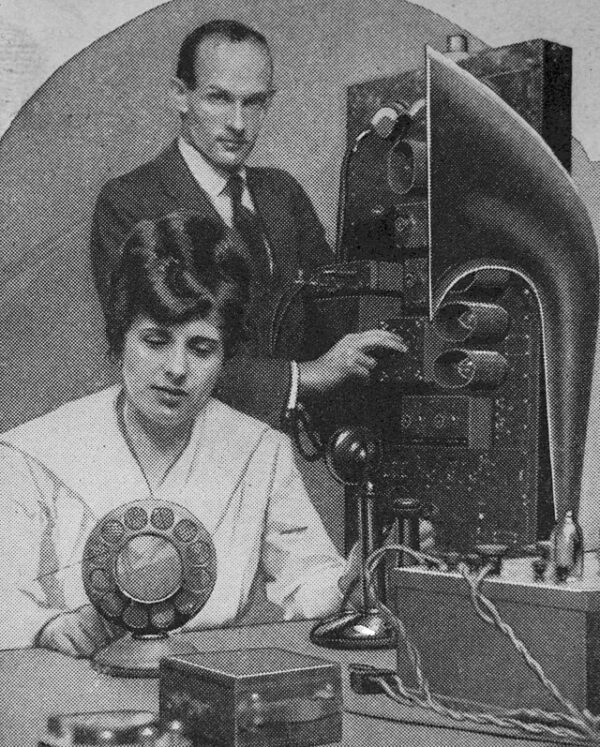
She also built her own Christian radio station called KFSG, reaching listeners as far as Hawaii. McPherson understood radio’s intimacy—a voice speaking directly into homes. She blended entertainment with religion and broadcast it worldwide, creating the template for American televangelism. As Schultz notes, “televangelism and radio evangelism would be unthinkable without the path blazed by Amy.”
The Scandal That Shocked America
In 1926, McPherson was at the height of her fame, preaching to thousands of devoted worshipers a week. In a USC survey, students named her as one of the top three most famous women they could think of—she was truly a household name. But all the pressure was beginning to take a toll. She had made herself available at all hours to the church and had no privacy or solitude.
She started a routine where she would drive down to Venice Beach from downtown with her assistant, rent a little tent for the day outside a hotel, sit in the sun, swim in the ocean, and work on her sermons. On May 18th, 1926, while writing a sermon called “Light and Darkness,” she was approached by a man and woman she had never seen before. They told her they had a baby in their car who was sick and asked if she would come and pray over her.
As a faith healer, McPherson was used to these requests. The Angelus Temple even had a dedicated room for all the crutches and wheelchairs left behind by people who had been “miraculously healed.” So she followed the couple to their car. But instead of finding a sick baby, she was hit on the head, had something put over her mouth, and passed out.
McPherson disappeared in broad daylight without a trace. Her thousands of followers launched a massive search. Fearing she may have drowned in the Pacific, divers combed the shallows of Venice Beach and Santa Monica. They even blasted the waters with dynamite hoping it might surface her body. One diver tragically died trying to find her, and another grieving church member became so distraught that she drowned herself.
According to McPherson’s account, she woke up chained to a bed in a shack near Agua Prieta, Mexico, held captive by people she called “Mexicali Rose” and “Steve,” who demanded $500,000 ransom. For weeks she remained restrained, growing delirious. But when her captors left to get groceries, she escaped by sawing the ropes around her wrists on the serrated edge of a can, fled through a window, and ran 20 miles through the blistering Mexican desert.
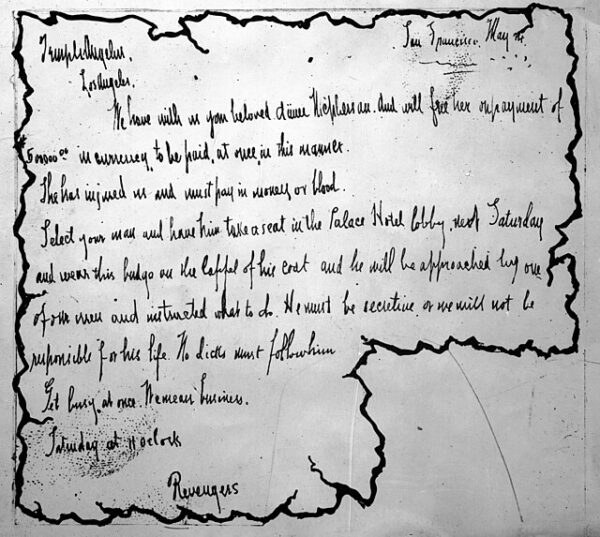
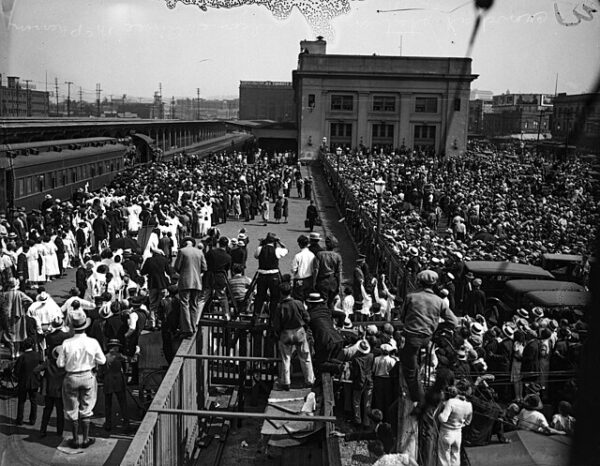
McPherson had been missing for over a month and was already presumed dead. Her mother had even held a memorial service at the Angelus Temple. But three days after that service, McPherson reappeared alive, mostly unscathed, and ready to tell her story.
Scandal!
The problem was, almost nobody believed her kidnapping story. Law enforcement immediately noted that it didn’t add up. By her own account, she had been walking 20+ miles in the blazing hot Sonoran Desert, yet when she was rescued, she was in suspiciously good physical shape—she wasn’t sunburned, cut, or bruised, and didn’t even ask for water.
Law enforcement was never able to locate the “shack” in Agua Prieta that she claimed she escaped from. Instead, they found tire marks about half a mile from where she showed up, with footprints that matched the slippers she was wearing. It looked like someone had gotten out of a car and walked over to the yard where she appeared.
There were also longstanding rumors that McPherson was having an affair with a married radio engineer at her station. This led to a theory that she hadn’t been in Mexico at all, but hiding out with her lover in California. Soon witnesses started coming forward claiming they had seen Aimee not in Mexico, but in Northern California, in Carmel by the Sea, wearing a disguise and living in what the press called a “love shack.”
The district attorney ended up charging McPherson with fabricating evidence, lying under oath, and conspiracy to commit a hoax. The pretrial hearing took months and set records for its cost—it was the most expensive trial in Los Angeles history until the Manson murders, making front-page news every day.
Through it all, McPherson stuck by her story, claiming the seedy gangster underworld, corrupt politicians, Satan, and the Catholics were all plotting to take her down. The charges were eventually dismissed before they ever went to trial because there wasn’t quite enough evidence to prove that she wasn’t kidnapped, and officials in Los Angeles were desperate to be rid of this case because of the media circus it had caused.
Legacy of America’s First Megachurch
Oddly enough, even with her name being dragged through the mud in every headline, the whole debacle ended up being great for the church. The Angelus Temple actually grew during the scandal—there really was no such thing as bad publicity. In terms of her fame, this was an era where figures came to embody single types: Babe Ruth as the athlete, Charles Lindbergh as the adventurer, and Aimee as the preacher.
For the next couple of decades, the Foursquare ministry expanded, but McPherson herself struggled. She suffered from poor health, poor financial decisions, lawsuits, a questionable third marriage, and ultimately became estranged from her own mother and daughter. On September 27th, 1944, while in Oakland for a series of revival meetings, she died from an overdose of prescription medicine.
Even after McPherson died, her church continued to live on and grow. There are thousands of Foursquare Churches around the world today with millions of members. While followers may remember Aimee Semple McPherson as an important religious figure, for those not in the church, she is more likely to be remembered for the scandal and tragic end to her life, if at all.
But her true legacy lies in what she accomplished architecturally and culturally. She really was a forerunner of getting Pentecostalism from the fringe into the mainstream. Now there are 600 million Pentecostals in the world—a quarter of the world’s Christians. It has moved from the absolute fringe to the mainstream, and she’s a big part of that story.
Walking around the Angelus Temple today, it’s clear that the building itself is a long way from its opulent beginnings. The church has had to evolve with modern culture, but modernization has sanded away some of the details that made this building singular. The prayer tower is now an HVAC room. The iconic KFSG station was sold to help pay for a parking structure. The 100-person choir has been traded in for contemporary music. Even that heavenly, sky-blue dome designed to evoke the outdoor revival is now obscured by sound-absorbing panels.
It may be a bit more subdued these days, but the Angelus Temple makes for a fitting monument to the woman who built it. Enormously influential, half forgotten, and even after all these years… still begging to be noticed.

Leave a Comment
Share