
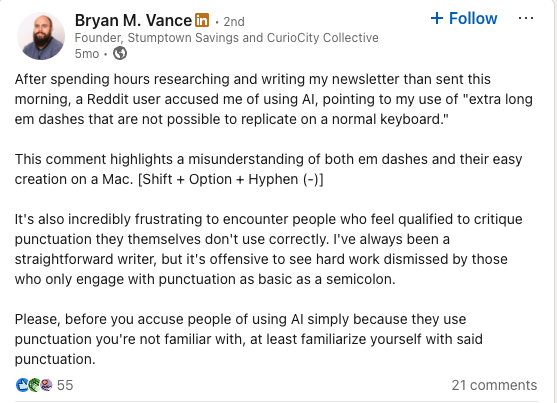
Last summer, Bryan Vance found himself in an argument with a stranger on Reddit. Vance, a Portland-based journalist who runs Stumptown Savings, a newsletter covering local grocery deals, had been accused of using ChatGPT to write his content. The evidence? His use of em dashes.
“A Reddit user accused me of using AI, pointing to my use of, quote, extra long M dashes that are not possible to replicate on a normal keyboard,” Vance recalls. The accusation stung, particularly because Vance spends 40 hours a week personally visiting grocery stores and crafting his newsletter by hand. “I’m a human, I can confirm I’m human,” he says.
This plucky bit of punctuation has had a very, very long literary history way beyond today’s tussles with technology. It’s been on a hero’s journey, playing the lead in an adventure story that has spanned both centuries and the pages of our most beloved plays, novels and poems. So who invented it—and why?
Humble Beginnings
The em dash gets its name from its width, roughly equivalent to a capital M. Its origins trace back to 11th century Italy and a scholar named Boncompagno da Signa, who practiced the formal art of composing letters and documents. Frustrated with the inconsistent punctuation rules of his time, he created his own system, including a horizontal dash called Virgula Plana that looked exactly like a modern em dash.
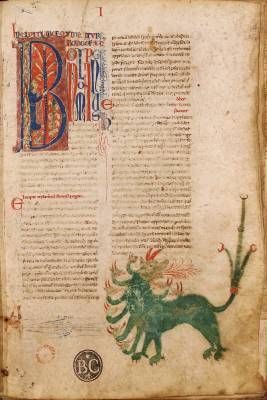
While his dash-as-period never caught on, the mark’s grammatical flexibility allowed it to evolve. According to Keith Houston, author of Shady Characters: The Secret Life Of Punctation, Symbols And Other Typographical Marks the dash slid into the printing era without a fixed purpose, which may have made it remarkably adaptable.
Shakespeare’s Stage Direction
By the 16th and 17th centuries, playwrights discovered the dash’s dramatic potential. They used it to indicate pauses, interruptions, and mid-speech realizations. Shakespeare’s First Folio is filled with them, giving actors flexibility in their performances and adding expressiveness beyond what periods and commas could provide.
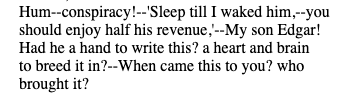
The dash became essential for capturing a theatrical technique called aposiopesis, speech deliberately broken off mid-sentence. In King Lear, characters trail off with dashes as they lose their train of thought or shift direction, bringing psychological realism to the stage.
A Novel Tool
When the novel emerged as a literary form in the 18th century, writers adopted the dash to capture authentic human thought and speech. Lawrence Sterne’s 1759 satirical novel “Tristram Shandy” deployed dashes with wild abandon, creating a stream-of-consciousness narrative that felt revolutionary. One short excerpt contains seven dashes used in every conceivable way. “It must have been like a bolt from the blue,” Houston says. “It must have been so incredible for people at the time to read this.”
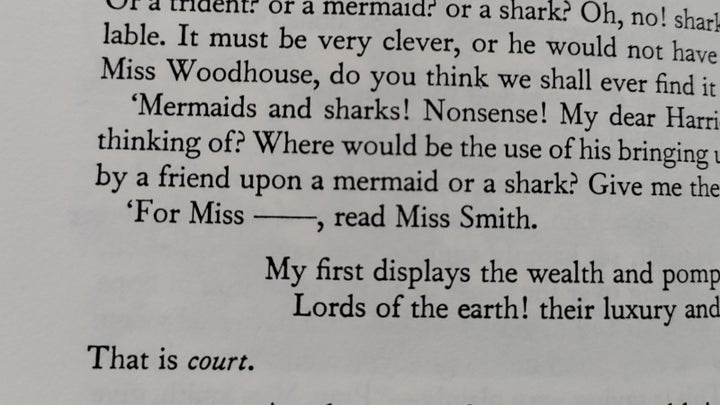
Novelists also used dashes for censorship, redacting names and locations to create an air of authenticity. Jane Austen employed this technique in her work, including in Pride and Prejudice using dashes to obscure military regiment names as if protecting real people’s reputations. The device added both realism and intrigue, helping sell these new works of fiction.
By the 19th century, dash usage exploded. Charles Dickens used one dash every 224 words in “Oliver Twist.” Herman Melville deployed them every 129 words in “Moby Dick.” Charlotte Brontë’s “Jane Eyre” features one every 90 words. But importantly, the em dash was a punctuation mark that could make a sentence feel more human. In real life we are naturally changing thoughts, cutting off others, or cutting off ourselves.
Emily Dickinson’s Signature
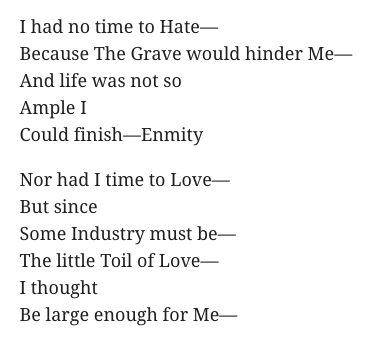
No writer became more associated with the em dash than Emily Dickinson. She composed nearly 1,800 poems in Amherst, Massachusetts, many during the Civil War, accompanied by thousands of dashes. Her dashes didn’t just indicate pauses; they captured the speed and ambiguity of human thought itself.
Dr. Fiona Green, who has studied Dickinson for decades, notes that the poet’s dashes create suspended moments of meaning. “She exploited unfinishedness,” Green explains. “The poems are always in the process, always undecided.” When Dickinson died in 1886, her editors stripped away most of her dashes before publication. Out of 1,151 dashes in her first collection, only 52 remained. Yet the poems became a sensation, never going out of print.
The em dash has always had critics. Jonathan Swift mocked excessive dashes in the 18th century. A reviewer complained about Lord Byron’s dashes appearing “sometimes twice or thrice in one line.” Modern style guides like The Chicago Manual of Style warn: “If in doubt, edit them out.” Even dash enthusiasts acknowledge the temptation to overuse it. “It’s easy to overuse the dash,” Houston admits. “I have to self edit to stop myself using it all the time.”
The ChatGPT Hyphen
Which brings us back to Bryan Vance and his Reddit troubles. Around 2024, people noticed that ChatGPT and other large language models had developed an em dash habit. The punctuation appeared so frequently in AI-generated text that younger internet users began calling it the “ChatGPT hyphen.”
When podcast host Theo Vonn asked OpenAI CEO Sam Altman about it, Altman claimed his team added more em dashes because users liked them. “Now I think we have too many,” he said. But Sean Goedecke, an industry insider, suspects something deeper happened.
When companies like Anthropic sought to expand their training data between 2022 and 2024, they turned to print books from earlier decades. Through “destructive scanning,” they bought millions of books, cut the pages from their bindings, and digitized them. “They kind of picked up the stylistic habits of these classic literature texts,” Goedecke explains, “which seem very incongruous when people use them today to write emails and job applications.”
The dash passed from Shakespeare’s hand into vast data centers, carrying centuries of literary tradition with it.
A Human Mark
It’s reductive to assume any writing with em dashes is AI-generated. After all, LLMs use the mark precisely because humans have deployed it for hundreds of years. There are subtler signs of AI writing: formal tone, specific vocabulary, a certain blandness. But the long, elegant dash is easy to spot and easy to target. It has become caught up in larger anxieties about artificial intelligence. For Dr. Green, the real concern isn’t spotting “real” versus “fake” writing. It’s what people surrender when they outsource thinking to machines. “Why would we introduce a machine? Why would we outsource exactly that perfect moment to something else?” she asks. “It’s the process of learning that then sends you out as a different human.”
In November 2025, Altman announced that ChatGPT would finally respect user requests to avoid em dashes. Perhaps some AI users will abandon them entirely. But for Bryan Vance and countless other human writers who appreciate its flexibility and flair, the em dash isn’t going anywhere. “It’s an odd thing to be a fan of an M dash,” Vance says, “but I am a fan of it. It’s a fun piece of punctuation.” After centuries of adventures across the pages of plays, novels, and poems, the em dash belongs with us.

Comments (10)
Share
Where can I get the “am dash”? Please post the link!
I would ordinarily never expose myself to the internet and all that comes along with it, but I had to comment on this episode. The em-dash is a topic near and dear to my heart. I wanted to add a little fuel to the pro-em-dash (with handlebars or otherwise) side of the discussion.
I’m a lawyer. My colleagues and I spend more time than we probably should debating grammar, sentence structure, and punctuation (you know, like whether to use the Oxford comma).
My favorite subject is the em-dash. I love it and I use it in almost every legal brief I write. I use them sparingly–usually to emphasize important parenthetical points–where commas just don’t get the job done.
I’m not alone in this. Bryan Garner, the editor of Black’s Law Dictionary and viewed by many (including me) as one of the leading advocates and teachers of good legal writing, feels the same. In his book The Redbook: A Manual On Legal Style (my trusty Second Edition from 2006), Garner writes of the em-dash:
“The em-dash (also called a long dash or just a dash) is a forceful and conspicuous punctuation mark. As wide as the font is tall and twice as long as the en-dash, the em-dash stands out on the page. It highlights what it either contains (when used in pairs) or separates from the main sentence. The same matter inside parentheses would be de-emphasized. As a separator, the em-dash often performs the pointing function of a colon, and the two marks are interchangeable in those situations. . . . Although you may have once heard a stern warning against em-dashes, they’re an important part of the writers toolbox. Just look at any page of first-rate published prose, and you’ll see one or more irreplaceable dashes.”
Mr. Garner captures my thoughts exactly. In a world where we need to persuade decisionmakers to pick the important points out of a word soup of legal briefs, the em-dash draws the eye to critical subject matter and helps ensure the key points get the attention they deserve.
As an em dash apologist, I was very excited to see this episode and really enjoyed learning the history of the punctuation mark. There is one thing I do think may have been overlooked, however, when it comes to why these LLMs are using the mark so gratuitously — fan fiction.
There have been several instances of sites like Archive of our Own being scraped for machine learning purposes, and for whatever reason, the fanfic community has a very soft spot for the em dash.
I am a graphic designer and unapologetic typeaholic, and I love the em dash (ALT+0151 on PC). Always have. It has a unique presence and gravity — when used correctly. I thought it was becoming dated, so I have been slowly scaling back when I use it. Am I trendy now instead?
One thing this piece doesn’t touch on, which has probably led to some of the suspicion of actual em dashes in the wild, is that, at least in the word environment, it is difficult to actually type an em dash. I love em dashes, but my work-around to get there is to type 2 hyphens, then a line break, then a backspace to remove the line break, and voila–an em dash in the wild. (Note, that I wasn’t able to do the magic on the one above, leading to its poor cousin, the double en dash).
Hello, I worked in trade book publishing at HBJ in San Diego 1982 to 1984. Trade means bookstore books not textbooks kids are forced to read. Anyway, the M dash is simpler than all this. Long ago, before computer word processing, people had to type a dash, composed of two hyphens next to each other. Then, once the manuscript was accepted by a publisher, the author was obligated to put a vertical line above each two-hyphen dash and a capital M below the dash with the two points of the M pointing at one hyphen apiece. It’s not Em; it’s M. Authors did this for type setters, whose business was totally separate from the publisher’s. There were typehouses in San Diego that we paid 50 bucks for one 8X10 sheet of camera-ready copy (I was in advertising). Now I can set type on this cheap $600.00 computer! The vertical line + capital M were visual aids to the typesetters.
If I’m not mistaken, MS Word will put an em dash inif you type a word hyphen a word .
Or I’m bot understanding what an em dash is.
I was a structural and safer Property Inspector for three decades,using a written format I developed for more clarity than most written reports. I used an em-dash after a concern and before a suggested ‘cure’. For example, «Most doors fit and latched well, other than the rear bedroom doors — simply snug up with a screwdriver». This mark was used only for the reason described…a suggested cure. The em-dash here was created on an iPad simply by tapping the standard dash twice, quickly. I added a space before and after the em-dashes because it looks more relaxed IMHO. One advantage of using an em-dash, as here, is fewer commas. Commas thus serve a different purpose than em-dashes. My example shows, to me at least, how special characters can indeed be flexible in new and different ways. They can also be fun.
“It’s reductive to assume any writing with em dashes is AI-generated.” I’d modify this to say, “It’s a weak heuristic to assume writing with em dashes is AI-generated.” (And, to even be considered as such, the writing in question needs to have been published online and in the last 3-4 years.)
Even that, though, fails to capture what’s going on here, which is a global assault on our ability to discern quality from slop. We had too much content before AI, too much to deal with or attend to, which was driving a race to the bottom of our attention. AI-generated content has made all of this much worse and is “flooding the zone.” Using simple markers to disqualify content as “AI” is a way to filter fast a ton of content. And you know what? What’s the risk? The reader who wrongly disqualifies content because of an em dash is on to the next thing.
For now, I think writers online have to accept this, as well as giving up other patterns (the worst being variants of “It’s not X. It’s Y,” which also includes things like “not only … but” and even “more than,” “go beyond,” etc. People are watching for quick ways to speed filter content online.
We have to. Fiat content is driving a hyperinflation of content. What else are we to do to save our attention?
I’ve always used them (good enough for the list of writers above – all of whom I love – good enough for me). The joke for me was (grammar confession…) I never knew they had their own name until the whole AI drama came along. To me they were always just a humble dash 😊