
In South Liverpool, there’s a neighborhood called Granby. It used to be one of the most vibrant and diverse neighborhoods in the UK. It had a busy main street lined with shops and cafes. But starting in the 1960s, the neighborhood began to decline. Over decades, it hollowed out, suffering through unemployment, aggressive policing, and failed redevelopment schemes.
The local government forced residents to sell their homes and then boarded them up. But before the authorities sealed each house, they gutted it. They would strip out the copper, the lead, and everything that was seen to have economic value, along with the toilets and any kind of infrastructure that would make the homes liveable. Then the council would place a sign on the front reading, “All items of value have been removed from this property.”
But a small group of residents would prove those signs wrong. They refused to leave the neighborhood, and they began clearing trash from empty lots, planting community gardens, and painting the boarded up houses in bright colors. Eventually they formed a Community Land Trust, or a CLT. Their goal was to take ownership of the empty houses and bring people back to the neighborhood.
Eventually the CLT realized it might be useful to have some folks on board who knew how to design and build stuff. Which is how a design collective called Assemble got involved. With Assemble’s support, the CLT pushed the local government to stop demolishing the remaining homes and then they worked together to renovate a handful of the old houses.
Granby Rock
As Assemble worked on the renovations, they began experimenting with the debris they pulled out of the old houses. Eventually, they set up a little backyard workshop with an artist named Will Shannon, and together they figured out how to make something they called Granby Rock.
Granby Rock was a kind of rubble terrazzo made from the broken bricks and bits of slate from the old houses. It was mixed together with concrete, poured into molds and then polished smooth. Granby Rock mantlepieces and countertops went into each of the renovated houses. “It just felt important as part of the process of reclaiming the narrative of these houses, of this neighborhood – that actually valuing everything that was there was important,” said Lewis Jones of Assemble.
Spolia
In the world of design, there’s a term that’s used for the practice of taking elements from older buildings and reusing them in new ones. It’s called spolia. What Assemble did in Granby was a version of that. The designers looked at the materials from the old houses and they saw an opportunity to make something new.
Reuse has always been an element of how humans build. But with spolia, the reuse isn’t just practical, it also carries meaning. In many cases, the old material has a history, and using it in a new building is a way of acknowledging that what came before still matters in some way. That might be why spolia shows up in some of the world’s most famous architecture, like the Hagia Sophia and the Great Mosque of Cordoba.
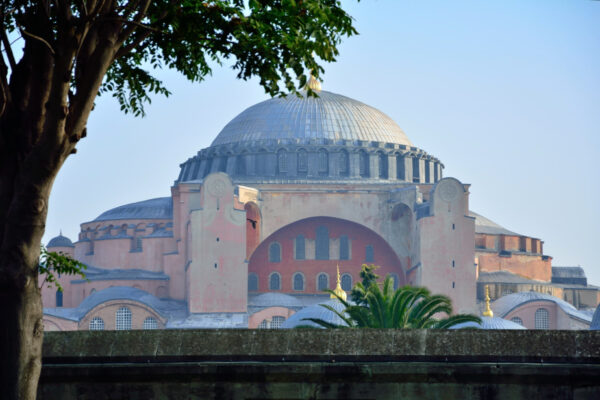
But to really understand spolia, you have to go back to the place where the practice first became widespread…
The Roman Empire
The Romans projected their power through architecture. Emperors built monuments to prove they were rich and legitimate. Emperor Augustus famously claimed that he quote “found Rome a city of brick and left it a city of marble.” Hadrian built the Pantheon, Trajan built his famous column. The Flavian emperors made the Colosseum.
Marble was the most expensive, durable, monumental stone to build with, and the Romans quarried it from all over their Empire. They got green marble from Greece and red porphyry from Egypt. After mining the marble, the Romans shipped it across the Mediterranean and used it to build the kind of magnificent structures they became famous for.
Crisis of the Third Century
Then, starting around the middle of the third century, the Roman Empire got hit by a series of overlapping catastrophes. Each one made the next one worse. There was political chaos, incursions by neighbors trying to steal Roman land, a pandemic, climate change, and hyperinflation.
During this time, nobody was really looking after the Roman’s magnificent marble buildings. There was a lot of deferred maintenance while people dealt with hemorrhagic fevers and famine and invasions from all sides. The result was that in Rome, there was a lot of beautiful, expensive marble just sitting there, slowly falling apart from neglect.
At the same time that was happening, Rome’s quarries in Greece, Egypt, and North Africa were becoming really hard to access. Travel and trade was much more dangerous. That meant if you wanted to build something impressive – and the Romans always did – you couldn’t just order up some new marble.
Enter Constantine
Constantine the Great grew up a soldier and he spent nearly twenty years fighting one civil war after another until he finally controlled the entire empire. Then he went about transforming it. He legalized Christianity and he launched an enormous wave of construction. Like every emperor before him, he understood the power of architecture.
Not long after his bloody ascent to power, the Roman Senate gave him a gift: a huge triumphal arch, right next to the Colosseum.
The Arch of Constantine was covered in panels with sculpted scenes on them.
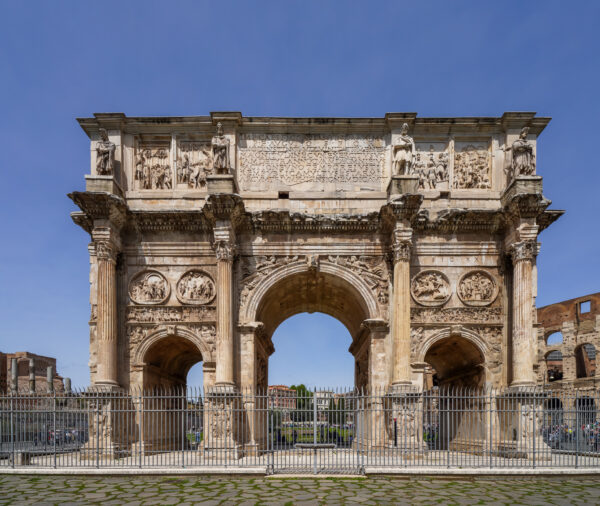
But many of those panels weren’t originally made for Constantine. They were taken from other monuments honoring emperors who’d lived around two hundred years before. This was a symbolic move. Because in a narcissistic twist, the images of the old emperors had been reworked to look like Constantine.
This effectively made it look like Constantine was doing all the stuff that the past emperors had done, like riding a horse over the bodies of his enemies, or addressing a crowd of troops, or hunting a lion. The idea was to remind people of when Rome was Great.
Spolia Supercharged
Constantine’s Arch was a masterpiece of political messaging, and it was also a turning point in the history of architectural reuse. There’s been debate among scholars about whether the repurposing of the panels was ideological or just practical, but a lot of them think it was meant to communicate something about the new political moment. It was re-use as propaganda.
Constantine’s reuse also set a new precedent. Soon, this kind of spolia was spreading. People started salvaging old columns, decorative friezes, and ornamental stonework. They would pull that material out of old buildings and use it in new construction.
Constantine had legalized Christianity, and now the faith needed a lot of grand new buildings to match its status as a legitimate religion. Huge basilicas went up across the empire and they needed marble. Thankfully, there were crumbling pagan temples everywhere, full of the kind of stone that would make the churches look spectacular.
The other thing that supercharged this new wave of architectural reuse was that Constantine had founded a new capitol, in Constantinople, and much of the new building in Constantinople involved materials salvaged from other places.
But not everyone was pleased with this wave of reuse. Especially in Rome, it sometimes felt like the city was being taken apart, piece by piece. There were even riots, people grew so displeased. And eventually, about fifty years after Constantine initiated this kind of reuse, later emperors passed laws trying to stop it.
Spolia eventually outlived the empire that made it famous. Wherever the Romans built stuff, later civilizations found their materials and put them to new uses. Roman tiles showed up in Medieval churches in England. Charlemagne installed Roman stonework in the chapel in his palace. Across the Islamic world, mosques were built with columns salvaged from Roman temples.
Learning from Spolia in the Era of Climate Change
Today, the vast majority of construction involves demolishing what’s already there and starting from scratch, with all new materials that are uniform and predictable, with no history and no variability. It’s often cheaper and more efficient than reusing old stuff.
But now, a growing number of architects and researchers think that reuse is a practice we need to relearn. Because it turns out that making everything from scratch, with raw materials, is something the planet can’t sustain.
It’s a compelling idea, but it’s actually hard to do. When you salvage something like an old steel beam, it’s hard to know exactly what it’s made of and what loads it can carry. There is no reliable supply chain for reclaimed materials, at least not at the scale we really need. There are architects and engineers considering the problem and trying to figure out how to make it easier.
Return to Granby
Back in Liverpool, the Granby project has continued. Since the early days of the Granby project, the architects and engineers at Assemble have started thinking much more about reuse in the context of climate change. The Granby workshop eventually grew into something bigger: a manufacturing studio in the neighborhood that’s still running today. It produces architectural tiles and ceramics out of recycled materials. They fire these tiles at lower temperatures, to reduce their environmental footprint, and they use electric kilns. So what started as spolia in the old sense has evolved into something that’s a practical recognition that we can’t keep extracting raw materials forever.
After all, the materials of the past are never worthless.


Leave a Comment
Share