
Jared Wilson is a seventh-generation farmer. He runs a family farm in Missouri, and like most farmers today, he’s facing a lot of challenges, including inconsistent weather and a shaky global economy. But one problem that’s been really vexing Jared for the past decade is the software on his tractor.
Most of Jared’s equipment is run by computer operating systems. And in many ways, this makes his life easier. For example, Jared’s tractor can run on auto-steer, which simplifies his job over a 20-hour shift. But according to Jared, the software also has some drawbacks.
 “If anything is not working correctly on the emission system, if you have a sensor, for instance, that has failed or malfunctioned,” says Jared, “it won’t perform the necessary emissions operations to satisfy the system, and [the software] will do something called a derate of the machine.”
A derating is when the tractor’s software slows down the machine’s horsepower to the point it’s basically unusable. Jared says there can be good reasons the software will do this, but there are times his machine has been derated, and an error code hasn’t told him why. According to Jared, diagnosing the problem requires an external tool, which can mean calling out a technician and waiting a day or two for one to show up. During harvest season, that kind of delay can be disastrous — crops go unharvested and revenue is lost.
“It’s difficult to convey how frustrating that is when you’re sitting on your hands and your crop is literally falling on the ground and you don’t have the ability to do anything about it,” he says.
 This kind of problem is one of the struggles of our increasingly digitized world. The more software is introduced into formerly analogue machines, the more power big companies have to control their products after they’re sold, and to charge consumers more money for repairs.
The novelist and activist Cory Doctorow has a word for this pattern: enshittification. In his most recent book, Enshittification: Why Everything Suddenly Got Worse, And What to Do About It, Doctorow describes a three-stage process: A company starts by being good to its users, then locks them in, then degrades the user experience to extract more profit. Doctorow originally coined the term to describe what happens on social media platforms, where users are lured in by the promise of community, and then forced to endure mark-ups, data collection and annoying ads.
But Doctorow argues the same logic is starting to apply to anything that runs on software, from tractors, to powered wheelchairs, to refrigerators. “William Gibson, the science fiction writer, coined the term cyberspace,” says Doctorow, “and in one of his books he has this line, ‘cyberspaces e-verting,’ so turning inside out. And what he means is that reality is being infected with digital stuff. And digitization is becoming a feature of things that weren’t digital before. Everything’s just becoming a computer in a fancy case.”
According to one 2023 survey, the average American household has about 21 connected devices, and every one of them is a potential enshittification vector.
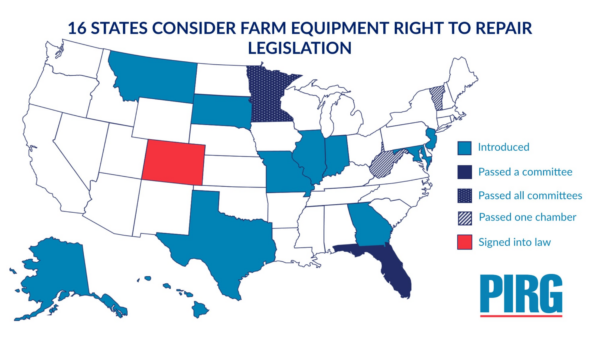
While these frustrations have become a part of everyday life, there are activists working to change the system. A movement called the “right to repair” has been picking up momentum in the U.S. and abroad. The argument is simple: if you own something, you should be able to fix it.
In 2024, the European Union passed a directive requiring every member state to have a right to repair law by summer 2026. Several U.S. states have passed their own versions covering farm equipment, electronics, and powered wheelchairs. And today, a bipartisan federal bill covering car repairs is under consideration in the House of Representatives.
On top of that, under pressure from activists, many manufacturers have released new software to give consumers more power over their devices. For example: a few years ago, the John Deere company released diagnostic tools which allow farmers to decode some error messages and, in certain cases, override a derating. But despite these changes, many advocates argue John Deere hasn’t gone far enough to address consumer demands, and in April 2026, the company agreed to pay $99 million to settle a class action lawsuit over repair restrictions. (John Deere did not admit to any wrongdoing in the settlement. Farmer Jared Wilson was part of that lawsuit.)
In Wilson’s view, it doesn’t benefit anyone to own things that are unfixable when they break. “It’s not good economically, it’s not good environmentally,” he says. “Allowing these companies to stymie competition is not in our best interests. And I really hope that people can take that to heart.”


Comments (2)
Share
The fact that you guys did not bring on Louis Rossman or mention the FULU foundation is such a missed opportunity. That man vehemently opposes section 1201 of the DMCA and has made several videos and issued bounties to open up the hardware of companies that have engaged in anti-consumer practices with these digital locks. You guys need to bring him on as a guest.
This makes me think of the movement for legislation ensuring military right to repair, so service members (vs outside contractors) can repair military equipment. When my son was in the Air Force he was a mechanic for B-1s. Some other systems, however, can only be repaired by the contractors who supply the systems. Not only is this expensive (of course) but it limits service members from acquiring advanced skills – one of the reasons some folks choose to enlist.