
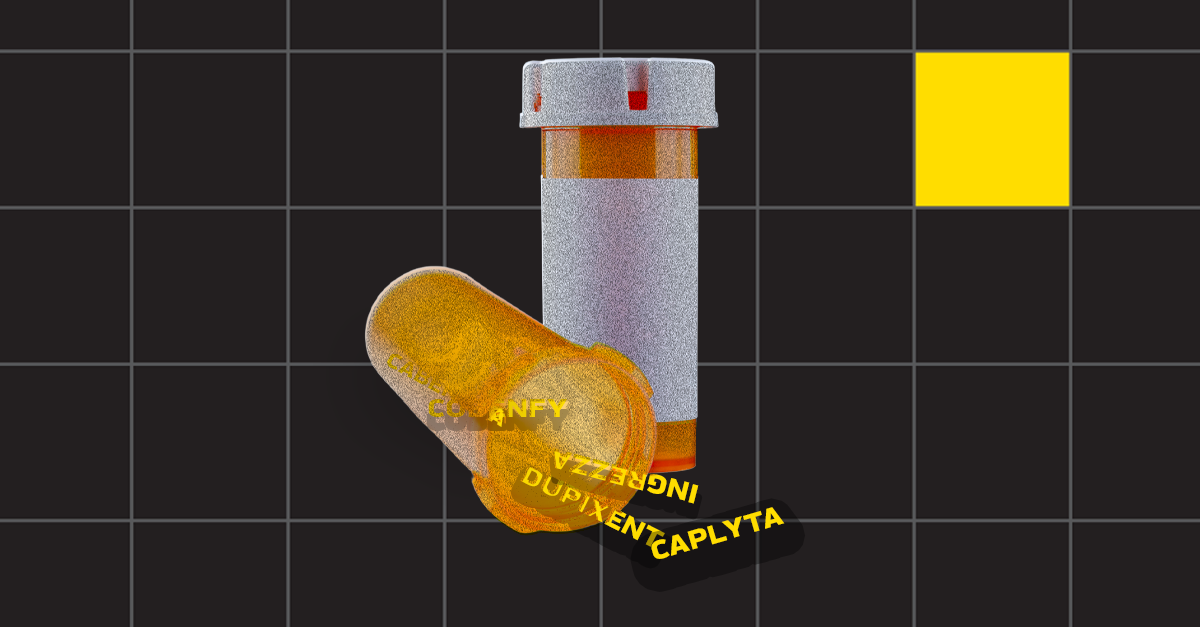
Watching television in the middle of the day can feel like half the words on the screen have been scrambled. Ebglyss. Bimzelx. Cobenfy. The brand names of prescription drugs have drifted so far from ordinary English that they’ve become a running cultural joke, routinely compared to sci-fi villains and alien planets. But the names are not random, and the reasons they sound the way they do are stranger than most people would guess.

Brand Institute, a single company, helps name more than 75 percent of the new drugs that reach the market in a given year. For each project, a small team generates hundreds of candidates, pulling raw material from foreign language dictionaries, anagrams, fragments of the generic compound, the drug’s mechanism of action. Where they land depends on the angle they choose. Lunesta works because of the lunar imagery plus the echo of “siesta.” Ambien breaks down to A.M. and “bien” (good morning). Belsomra folds in “belle” and “somnus,” the Latin word for sleep. Same section of the drug store, three different ways of getting at the same idea.
Arlene Teck, a veteran namer with more than thirty years in the industry, works more by instinct. In 1992, assigned to name a drug for enlarged prostate, she ran a focus group with urologists. One doctor’s phrase stuck: visualize a strong stream. A strong stream would be vigorous. The most vivid stream she could think of was Niagara. Vigorous + Niagara = Viagra. That name was never used for the prostate drug. It sat in a bank until Pfizer needed it for a different compound whose clinical trial had turned up a far more marketable side effect.
The big bang of pharmaceutical naming came in 1988 with Prozac: short, punchy, all marketing and no indication of what the drug did. That year, 17 drugs were approved by the FDA for therapeutic use. Last year, almost 50. The number of letters in the alphabet has not increased to match. The FDA regulates what drugs are called as well as what’s inside them, and the core concern is patient safety: names can’t look or sound too much like existing drugs. A patient died in the late 80’s after a nurse confused the ulcer drug, Losec, with the diuretic, Lasix. Losec was renamed Prilosec, which then started getting confused with Prozac.
Those constraints explain why the names look so alien on the page. Namers think about the physical shape of a word, what they call its perceptual silhouette. Picture a city skyline reflected in a river. Letters that ascend (l, t, h), letters that descend (p, q, g), and flat letters (a, e, s) all need to be in the mix so the word has a distinctive profile, harder to mistake for another drug on a prescription pad. A Q can do the work of a C while giving the word a descending tail. Y gets special treatment: the only vowel with a descending stroke, since A, E, I, O, and U all sit on the same visual plane. A drug approved last year, Tryptyr, uses it twice.
Teck also writes haikus. She resisted the comparison to her naming work for a while but eventually conceded the overlap: in both, the sound of the thing is everything. A good drug name has to feel like it fits in your mouth, and she would sing candidates to herself while working, because a name that sings is a name people can say. Her name for the long-acting insulin, Toujeo, started from the prompt “your friend for life” and grew into a romantic story about young diabetics suddenly free to stay out late. She didn’t need anyone to know that story. She just needed the word to carry it. Toujeo comes from the Haitian Creole “toujou,” meaning always, and if you say it out loud you can hear what she was after: something that moves through the mouth the way a good line of verse does, with just enough music to stick.


Leave a Comment
Share