
For over half a century, millions of children have learned their ABCs and 123s from Sesame Street. But the beloved show has been teaching something else entirely… a quiet lesson in what makes a great neighborhood.
“I had a lot of people reach out and say they think this is why they always wanted to live in a walkable neighborhood, because they watched Sesame Street growing up,” says Anna Kodé, a New York Times journalist who covers the built environment. Her recent investigation into the show’s iconic set revealed something remarkable: Sesame Street isn’t just entertainment. It’s a blueprint for urban utopia.
A Revolutionary Vision
The story begins in 1966 with Joan Ganz Cooney, a media executive fresh off an Emmy win for her documentary on the War on Poverty. Cooney saw television not as the “vast wasteland” critics described, but as a powerful educational tool. Her research revealed that more households had televisions than bathtubs, telephones, or daily newspapers. If TV was already capturing children’s attention nationwide, why not harness that power for good?
Working alongside producer Jon Stone, Cooney developed what would become Sesame Street. But Stone’s vision for the show’s setting surprised everyone. In 1968, while watching a public service campaign called “Give a Damn” that showed children playing in Harlem’s gutters, Stone had an epiphany: the show needed to be set on a city street.
“When he had the idea to set the show on a street, the color from Joan’s face just drained,” Kodé recounts. “She was like, wait, what? How are we going to do that?”
An Unlikely Setting
The timing seemed impossible. Late 1960s New York was plagued by crime, riots, and white flight to the suburbs. Cities were viewed as places to escape, not celebrate. But Stone saw an opportunity. If the show aimed to reach inner-city children and close the achievement gap, it needed to depict an environment they would recognize as home.
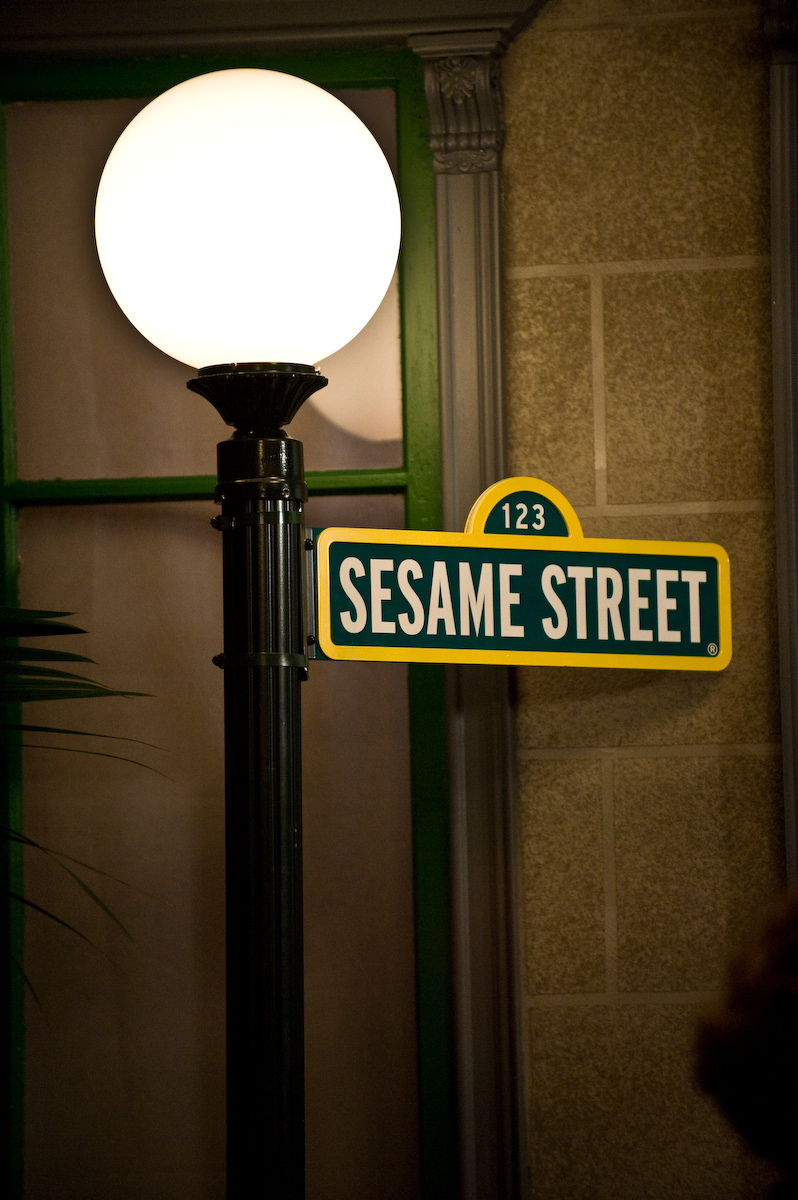
Stone and his set designer scouted Harlem, the Upper West Side, and the Bronx, creating an authentic amalgam for 123 Sesame Street. They didn’t sanitize it—there’s litter on the streets, Oscar lives in a trash can, and the brownstone shows real urban wear. But instead of riots and crime, the show depicted something different: a harmonious, integrated community where neighbors resolve problems together.
“They wanted to create an environment that would look familiar and look like home,” Kodé explains. “But what’s going on is this harmonious, happy little village where people get along.”
The Jane Jacobs Connection
Unknowingly or not, Sesame Street’s creators aligned themselves with the ideas of Jane Jacobs, whose 1961 book The Death and Life of Great American Cities had become the bible for urbanists. Jacobs championed mixed-use, pedestrian-friendly neighborhoods over the bulldozing approach of planners like Robert Moses. She identified four conditions essential to vibrant city blocks—and Sesame Street embodies them all.
First, multiple functions. Sesame Street has a laundromat, convenience store, multi-family apartment building, and more. “It’ll never be totally dead and empty,” Kodé notes. “You’ll always have people there.”
Second, short blocks. More corners mean more casual encounters and a more dynamic neighborhood experience.
Third, a mix of old and new buildings. When the set was redesigned in the 1990s, designers deliberately kept the original brownstone alongside new structures. One designer said it was “meant to look like a survivor of gentrification.”
Fourth, high population density. More people means more “eyes on the street,” making neighborhoods safer while supporting local businesses.
When these elements combine, Jacobs wrote, they create what she called the “sidewalk ballet” – spontaneous, improvised interactions in public space. The very first scene of Sesame Street’s pilot episode demonstrates this perfectly. Gordon walks newcomer Sally down the block, greeting Mr. Hooper buying his newspaper, waving to his wife Susan in the window, encountering Big Bird. It’s the quintessential sidewalk ballet: “Little moments of human interaction that are unplanned and pretty minor, but altogether they make you feel like you’re part of something greater.”
“I think Sesame Street is very idealistic,” Kodé says. “The creators wanted to give children a vision of how urban life could be. But there’s also a power within that kind of idealism.”
Loretta Long, who played Susan, the Black homeowner of 123 Sesame Street, captured this perfectly in her memoir: “Not only were we a black married couple, we also owned that house. We were landlords, which was not the typical case for Black families on television.”
On a show with talking monsters and a giant yellow bird, depicting Black homeownership felt not just possible but natural. “It’s already a show that has little monsters running around, right?” Kodé points out. “Like why not show something like Black homeownership?”
The stories we tell our children shape what they believe is possible – whether that’s owning a home, building better cities, or creating communities where everyone belongs. For fifty years, Sesame Street has been showing us the way. The question is whether we’re still willing to follow.



Comments (2)
Share
https://youtu.be/ydNHAKn-YDI?si=tvP1qneZS87hglTc
After listening to the slide story and your reference to introducing the concept of risk taking, I have to mention City Museum St. Louis. I’m 60 something and I still go there every chance I get. I don’t take the 10 story spiral slide every time I visit. Nor do I climb the giant rope net to the (real) fighter jet that somehow became entangled there or go into the school bus teetering over the edge of the roof of tge 10 story building, but it’s nice to know I can.
The “museum’s” creator, Bob Cassilly was unique in his approach to art and design. He is no longer with us but luckily his approach was infectious and many others have caught the bug, so his work and project continues. There is something new to see and try every time I go. Speaking of risk taking I somehow didn’t make it there during the time when there was a shark petting tank.
https://en.wikipedia.org/wiki/Bob_Cassilly
Check it out next time you’re there…
Your story about the big swing and the idea of introducing risk taking. Reminded me of City Museum St. Louis. I don’t climb the rope net to the fighter jet that somehow got stuck there or go into the school bus teetering over the edge of the 10 story building every time I visit but it’s nice to know I can. The museum’s creator Bob Cassilly is no longer with us, but his childish approach to design and pushing the limits of what is possible and ‘allowed’. Is infectious, so his work and project continues. I’m just sorry I never got a chance to visit while the shark petting tank was there.
https://en.wikipedia.org/wiki/Bob_Cassilly