
This week, two stories about the history and uses of the 1-800 number.
1-800-PODCAST
Today, shopping is almost completely detached from time and place. At 3 a.m., you can order something from your phone and have it delivered the next day. The impulse to buy no longer has to wait for a store to open.
That idea can be traced back to a surprisingly old technology: the toll-free 800 number.
When AT&T introduced its inward Wide Area Telephone Service, or inWATS, in the 1960s, the goal wasn’t to revolutionize shopping. It was to solve a simpler problem: long-distance calls were expensive. For ordinary Americans, calling across the country was a luxury, not something you’d do just to buy a new dishwasher.
Businesses, however, had an incentive to absorb that cost. Before 800 numbers, customers could make collect calls, but that required an operator to connect the call and the business to accept the charges. The 800 number automated the entire process. Customers paid nothing, while the business paid for the call.
At first, consumers weren’t sure what to do with this new convenience. Catalog retailer Alden’s even launched “Jet Phone Service,” promoting its 800 number as a futuristic way to order products. But only about five percent of its orders came by phone. Most customers still filled out paper forms, wrote checks, and mailed their orders. The culture of instant shopping hadn’t arrived yet.
That changed in the 1970s with the rise of credit cards. The 800 number removed the cost and inconvenience of the call; credit cards made payment nearly effortless. Together, they allowed retailers to turn shopping into something that could happen almost anywhere and at any time. The 800 number didn’t just make shopping easier—it changed when people could shop.
The transformation accelerated in the 1980s after AT&T was broken up. Competition drove down the price of toll-free numbers, making them affordable for smaller businesses. Television commercials began filling the airwaves with instructions to “call toll-free” to buy everything from books to kitchen gadgets. By the mid-1990s, more than $130 billion worth of goods and services were being sold through 800 numbers—nearly two percent of the country’s GDP.
The numbers also became marketing tools. Businesses competed for memorable vanity numbers such as 1-800-LAWYERS and 1-800-FLOWERS. A toll-free number could make a local company feel national, accessible, and available around the clock.
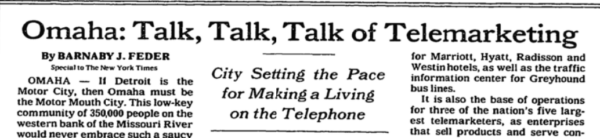
It also changed where businesses operated. Omaha, Nebraska, became an unexpected center of the toll-free economy because it had unusually extensive telephone infrastructure, originally developed because of its role as a Cold War military hub. Companies began concentrating customer service in large Omaha call centers instead of maintaining offices around the country.
More than 10,000 Omahans eventually worked in these centers, answering calls for companies nationwide. Television advertising could produce sudden waves of calls: a commercial would air, and dozens of phones could begin ringing simultaneously. The 800 number had become more than a telephone service. It was infrastructure for a new economy: national, centralized, always available, and designed to turn consumer attention into immediate action.
Eventually, though, technology moved on. Cell phones made nationwide calling inexpensive, reducing the original reason for toll-free numbers. Outsourcing moved many call-center jobs overseas. Then the internet transformed shopping, replacing telephone orders with websites, apps, email, and online chat.
But 800 numbers never disappeared completely. For people without reliable internet, unlimited mobile data, or the ability to navigate websites and chatbots, a toll-free number can still provide an important connection to a business. The number can also signal legitimacy and accessibility in a world increasingly filled with automated systems and spam calls.
There is an irony in that legacy. The 800 number helped establish the expectation that businesses should be available whenever consumers want them. Today, you can call one and end up talking to a chatbot. Still, the fundamental idea remains. The 800 number helped remove distance, reduce friction, centralize customer service, and turn shopping into a 24/7 activity.
The modern retail economy didn’t invent the idea of shopping whenever you want. The 800 number taught us to expect it.
Call Now!
When it’s three o’clock in the morning and everything is going wrong in your life, there’s a certain kind of ad you might see on basic cable. Lawyers — usually guys — promise to battle the heartless, tight-wad insurance companies on your behalf. There’s disaster footage and stiff readings off of cue cards. The ads look like they were made in a high school A.V. class.
Believe it or not, lawyer ads are actually tightly regulated. There was an era before ads like these were allowed — and a big bang after which they couldn’t be contained. And now, the legal world is in a subtle, possibly endless civil war over how attorneys should advertise their services (and whether they should advertise at all).
Of the most outspoken attorneys in front of the camera, there are Lowell “The Hammer” Stanley, and Jim “The Hammer” Shapiro, and Jim “The Texas Hammer” Adler.
But lawyer ads were not always so direct.
Back in the 19th century, you’d see ads for attorneys on the front page of newspapers, alongside ads for doctors, and saddle and harness manufacturers. But in 1908, the American Bar Association put in new rules declaring that self-laudation (that is, speaking well of oneself) “defies the traditions and lower the tone of our high calling and are intolerable.”
Business cards were okay, but not much beyond that. The ban lasted until 1976, when the Law Clinic of Bates and O’Steen ran a small classified ad in the Arizona Republic. The Arizona Bar suspended the two lawyers (but only for a week or so). Bates and O’Steen appealed the case all the way to the US Supreme Court. And, in the now infamous Bates vs. State Bar of Arizona, the court ruled that lawyers have the same freedom of speech as everybody else — and that speech extends to advertising.
That pretty much opened up the flood gates. Which is how you get promises of a pain-to-rain alchemical process.
Today, laws governing lawyer ads vary state by state. Florida, Texas, and Iowa have some of the stricter regulations, although reprimands for breaking them are not that severe.
Massachusetts and Connecticut, meanwhile, are like the wild west of lawyer ads. Though this New York ad, featuring a bilingual anthropomorphic squirrel, has to be one of the most surreal:
Though Jamie Casino’s Superbowl ad has to be the most epic ever.
Our Tiny Letter Spotlight is on Wendy MacNaughton this week.
 Wendy’s book, Meanwhile in San Francisco: The City in its Own Words, is incredible.


Leave a Comment
Share