
The Hidden Levels Original Soundtrack is now available everywhere!
Up, Up, Down, Down, Left, Right, Left, Right, B, A…Start. It’s one of the most famous video game cheat codes … and it’s easiest to execute using a piece of gaming interface technology so fundamental that it has remained largely unchanged for decades.: the joystick But these didn’t start as parts of a console or arcade systems. In fact, their basic design predates video gaming by generations, and is grounded in aviation.
 The Wright brothers’ first successful flight required awkward full-body movements. Then, in 1907, French pioneer Robert Esnault-Pelterie patented the idea of a single stick to control both the up/down and right/left movement of a plane, presaging the modern arcade and console game controller as we know it.
But it would be 70 years before this pragmatic design solution made the leap into recreational everyday culture. The iconic, widely accessible video game joystick debuted with the Atari 2600 in 1977. The intuitive design made it feel like a seamless extension of the player’s will, requiring only experimentation (rather than a manual) to operate.
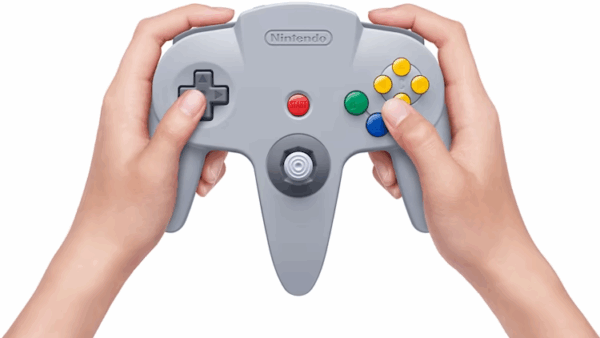
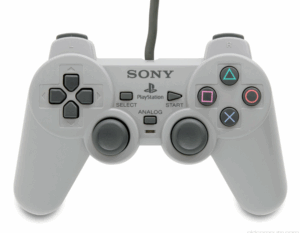
Later, 2D gave way to 3D worlds in the 1990s with games like GoldenEye 007, the rigid single-stick solution was no longer sufficient. The highly responsive thumbstick, as seen on the Nintendo 64, began to change the game . It was later folloewd by the dual-analog thumbstick controller, pioneered by the Sony PlayStation in 1997, which allowed players to separate “looking” (aiming with one stick) from “moving” (navigating with the other). This dual-stick design proved to be an optimal interface and remains the industry standard today.
This refined dual-stick interface has jumped back out of the realm of recreation as well, now used for consequential, real-world tasks in the military and medicine. The U.S. military, for example, utilizes ruggedized video game controllers, and even actual Xbox controllers, to operate high-precision systems like unmanned drones, turrets, and bomb-finding vehicles. In military contexts, intuitive usability is bolstered the familiarity that younger generations of troops already have with contollers.
Similar interfaces are also being adopted in medicine for delicate procedures, like endoscopy and bronchoscopy, where their design is leveraged for precise control over remote instruments.

At the same time, gaming interfaces have started to trend in new and different directions. There are some more immersive interfaces, to be sure. But in a lot of cases, screens have increasingly taken the place of physical controllers, flattening our interactions and removing us further from that direct and tactile feeling of virtual control.




Comments (2)
Share
Can only use the VCS joystick for 10 mins? Blah, kids these days. I used to play the VCS for hours on end and wouldn’t have stopped except for the parental units. ☺
Until you had 360 joysticks, and then if you didn’t go straight “up” enough, or “down” enough, or “left” enough, or “right” enough…. Most annoying part was having to restart the game just to try and enter it at the title screen again…..
Had an Atari 2600 mid-80s, but NES came out about that time (at least in Asia, where I was living at the time), so mostly we played NES. I just looked it up… I guess it was called the “Famicon.” It was actually different.. In fact, I remember when we moved back to the U.S., and I saw what the American NES looked like, I was a) confused, and b) disappointed none of my games could be played on that machine. And I couldn’t sell my Famicon to anyone in the U.S. when I got bored of it (playing the same five games over and over when you can’t buy new ones), because you couldn’t buy cartridges for it there. It was just a couple years of my life in Asia where that existed… playing Final Fantasy long before it was released in the U.S. (which didn’t last long for me, since all the text was in Japanese, and there was a LOT of text, so I never even figured out how to play it), playing Mario 3 two years before it would ever hit the U.S.
What I’m surprised didn’t get mentioned in here was the running pad for NES Track and Field. That was revolutionary. The fact that you could basically take part in the game, in a very active way. Of course it didn’t take some people long to figure out how to cheat at long jump (step off the pad), but if I recall, jumping for too long would cause the player to crash land, and it wouldn’t count, so the trick was to “be reasonable” in your cheating…