
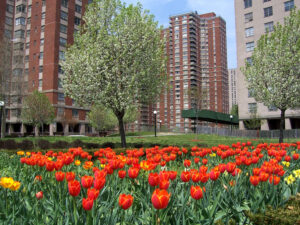
Driving into New York City from the north, an unavoidable cluster of thirty-five identical brick high-rises dominates the horizon just past the Bronx border. All of them over twenty stories tall, all with the same brick facades. They’re easily mistaken for a public housing project. But the complex is Co-op City, the largest housing cooperative in the world. Residents like Diane Patrick, who moved in back in 1978, don’t pay rent, but they don’t exactly own their units either. They buy shares in a corporation, paying monthly carrying charges that cover the mortgage and utilities, and they can renovate their apartments however they like. For Diane, who spent years working in real estate and watching people pay obscene prices for tiny Manhattan apartments, Co-op City is housing made for ordinary people.
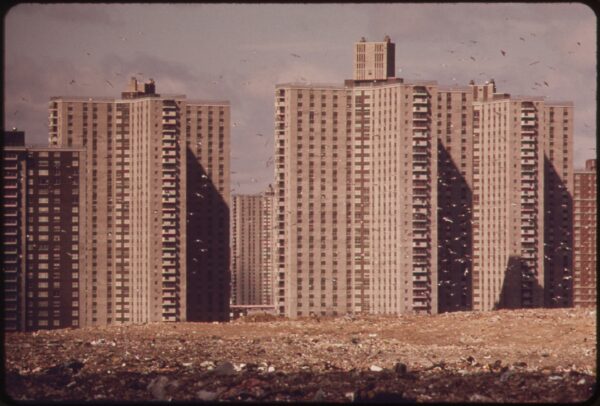
The development traces back to Abraham Kazan, a Russian immigrant, socialist, and union organizer who became convinced in the early 1900s that unions should build their own apartment buildings and let members become collective owners, cutting out the predatory landlords who ran the tenements where garment workers lived. His cooperative housing idea was initially mocked by his own peers in the labor movement. He built anyway. By the late 1920s, Kazan and various union partners had put up buildings housing more than 850 working-class families. After World War II, an acute housing shortage and new federal urban renewal funding put Kazan’s organization, the United Housing Foundation, in business with the city’s most prolific and problematic planner, Robert Moses. Moses wanted to clear neighborhoods he deemed blighted. Kazan had the organization to build over the rubble.
 In 1955, New York State created the Mitchell-Lama program, offering low-interest mortgages and tax breaks to developers who built middle-class housing. The United Housing Foundation grew fast under the program. Their projects got bigger. The Penn South Cooperative in Manhattan was ten buildings, all about twenty stories, and fifteen thousand people showed up to its dedication ceremony in 1962, including JFK. But each project required demolishing old neighborhoods and displacing residents. Robert Caro estimated that Moses evicted a quarter million people to build highways in New York City, and another quarter million for urban renewal projects.
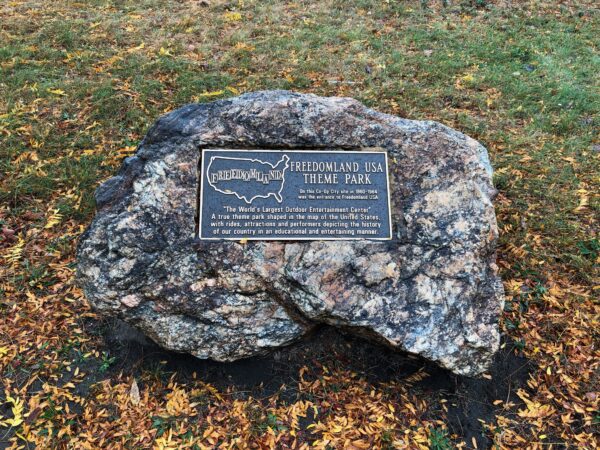
Jane Jacobs argued that the places being condemned were functioning communities, and that the sterile architecture replacing them killed the possibility of real neighborhood life. Looking to build even larger without the political cost of mass displacement, Moses and Kazan secured a four-hundred-acre swamp in the north Bronx that had briefly hosted a failed history-themed amusement park called Freedomland.
A few months after Co-op City opened on the site in late 1968, a blizzard buried New York City. Cars were abandoned on I-95 right past the development. Residents left the buildings, pulled stranded travelers inside, and brought them hot drinks while kids had snowball fights in the green spaces between the towers. It became a kind of founding story for the place, and an early rebuttal to critics who insisted that real neighborhoods couldn’t form inside modernist superblocks.
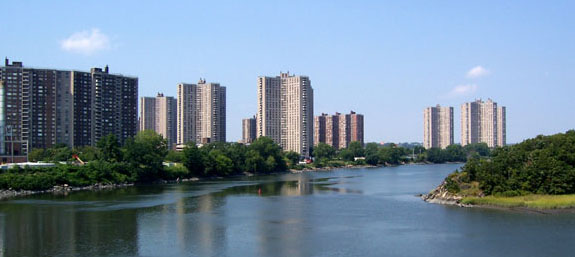
But building thirty-five skyscrapers on top of a swamp was not easy or cheap. The mortgage ballooned from $235 million to $391 million during construction, and the United Housing Foundation passed those costs to residents through increased carrying charges. When people complained, the UHF lectured them about the sacrifices of cooperative living. Residents had no voting power on the board that controlled the development. If you raised a complaint about costs or broken air conditioning, the response was essentially that you didn’t understand what it meant to be in a cooperative. Frustrated residents organized a thirteen-month mortgage strike, withholding their monthly checks and maintaining the buildings themselves. A lot of them were union members. They knew how to run a strike. In the end, the state conceded control of the board to the community. The United Housing Foundation never built another cooperative.
By the mid-1970s, the era of big-government liberalism that had made all this building possible was over. New York City was teetering on the edge of bankruptcy. The white flight that Moses had tried to stave off came to Co-op City. Early residents had been about eighty percent white and mostly Jewish, but over the course of the 1980s the development became a majority Black community. Co-op City avoided the decline that typically accompanied racial change in other neighborhoods. It stayed middle class. The equity deposit that the UHF had always been so insistent about may have had something to do with it. By the mid-seventies the Black middle class had grown, and families who could afford that upfront investment had a real stake in the place. Co-op City became a hub of early hip-hop culture, with students from the on-site Harry S. Truman High School appearing in the 1986 documentary Big Fun In The Big Town, the towers visible behind them.
 Today, Co-op City is the largest naturally occurring retirement community in the nation, an affordable place to live on a fixed income in one of the most expensive cities in the country. New York’s new mayor, Zohran Mamdani, has proposed building 200,000 units of affordable housing over ten years. The last time anyone built housing at that scale in New York, it was after World War II, spearheaded by people like Moses and Kazan, and they made extremely harmful mistakes along the way. They bulldozed neighborhoods and treated whole communities as expendable. But the ambition to solve a housing crisis wasn’t a mistake. And in a city once again wrestling with how to house the people who keep it running, the question isn’t whether the government should attempt something that big again. It’s whether it can afford not to.



Leave a Comment
Share