
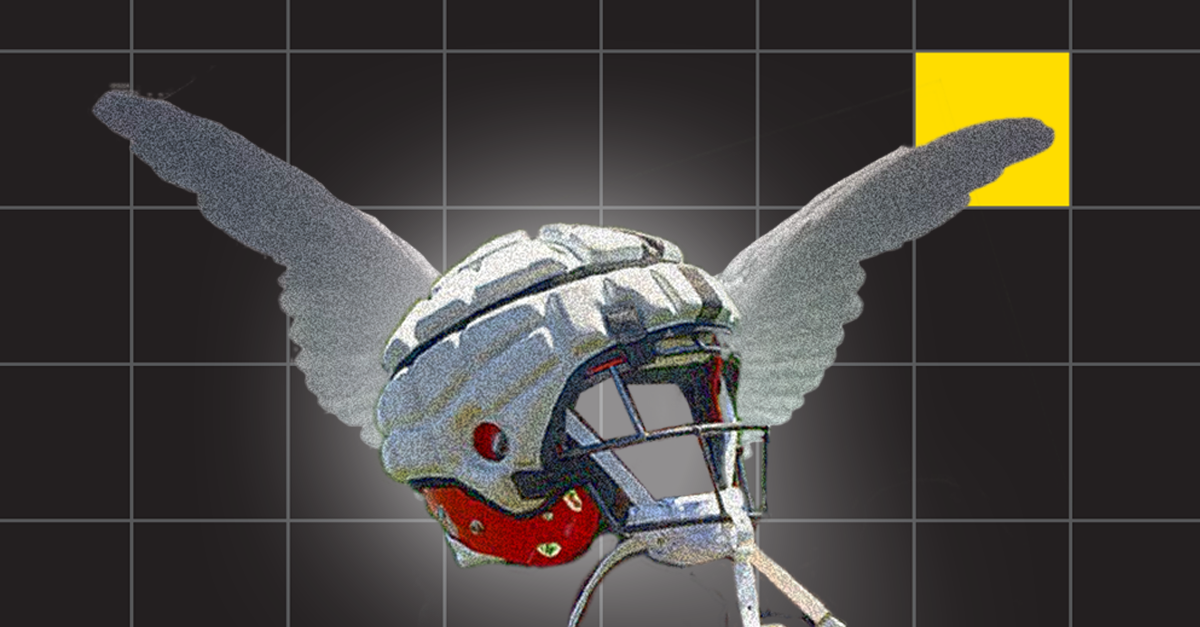
In 2024, James Daniels became likely the first NFL football player to wear a new kind of helmet during a game – an apparatus called the Guardian Cap. The new lid was a marked departure from what fans are used to. Guardian Caps offer an extra layer of padding, and make the player’s helmet more bulbous and large. “It sort of looks like if you had soundproof padding in the form of a cap and stretched that over your helmet,” says Noah Cohan, a professor of American cultural studies at Washington University in St. Louis. “It’s a series of lumps made of foam within a sort of fabric covering that is then clipped to the outside of the helmet.” The Guardian Cap is designed to protect players’ heads from injury, and has been controversial with players and fans alike.
The Cap is one of the latest developments in a nearly century-long quest to make the game of American football safer. In the early days of football, players were often bare-headed, before leather helmets became mandatory in college football in 1939. Plastic helmets became popular a few years later, thanks in part to their ability to prevent skull fractures – and their appealing design, which helped make the football helmet into a symbol for the game itself. More recent helmets have used more flexible materials and 3D printing to create equipment that manufacturers tout as more technically advanced than ever.
However, recent concern around concussions and CTE have raised the question of whether it’s technically possible to develop a helmet that can totally prevent injuries during gameplay. “I remember chatting with a doctor who said, unless you strapped the helmet to a player’s shoulders so that your head couldn’t move around on your neck, the helmet really can’t do all that much to prevent a concussion,” says Kathleen Bachynski, an associate professor of public health at Muhlenberg College. “I do think you can tweak design around the edges, but I think you’re up against the law of physics.” As debate rages around the safety of America’s most popular sport, helmets will continue to be a flashpoint.
This episode featured interviews with: Noah Cohan, whose book about the history of football helmets will be released next year; Kathleen Bachynski, the author of No Game for Boys to Play, about the history of youth football; George Visger, a retired NFL player and author of Facing Giants: My 38 Year Battle; and an excerpt from Chuck Klosterman, author of a recent book simply titled Football.


Comments (1)
Share
I was waiting anxiously for the transcript to come out for this episode — fascinating, if horrifying, stuff. I was already aware of the problem of CTE, but the under-count on the stats was new to me, as was the history of the game. (Skull fractures! From a sports game! Yikes!)
Unfortunately, I think Klosterman’s point about the appeal of risk is a very valid one. I’d be very interested in how the level of risk sought out in sports entertainment might track with other societal factors/historical trends. (I’m thinking of extreme sports, like the X-Games, or sports/entertainment like MMA (versus boxing), various daredevil stunts….)